

-320x320.jpg "MIG/MAG Welding Machines")
-320x320.jpg "TIG AC/DC Welding Machines")




-320x320.jpg "Electrodes for High-Alloy Steel")
-320x320.jpg "Surfacing Electrodes")
-320x320.jpg "Electrodes for Cast Iron")















-320x320.jpg "Welding Masks")





-320x320.jpg "Welding Machine Carts")


















How does a plasma torch work?
Published:
20/07/2026
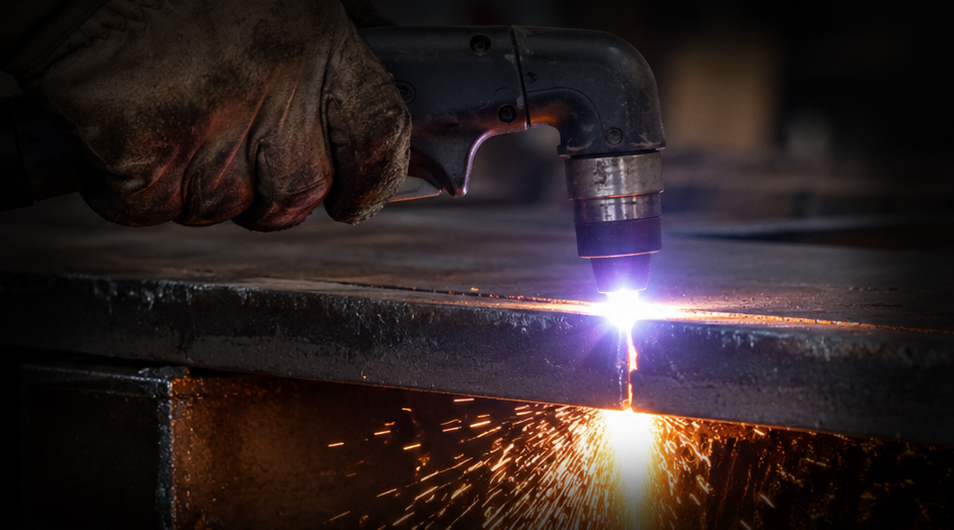
The operating principle of a plasma torch is based on creating a plasma arc that melts metal and blows the molten material out of the cut zone. A plasma torch is used for processing steel, stainless steel, aluminum, copper, and other conductive materials. For plasma cutting to be stable, it is important to understand the torch design, the role of consumables, and air requirements.
A plasma torch is the working part of a plasma cutter. Current and compressed air are supplied through it, plasma is formed inside, and a narrow cutting arc appears at the outlet. Thanks to the high temperature and flow speed, metal is cut quickly, and the edge is accurate enough for further processing.
What a plasma torch is and where it is used
A plasma torch, or plasma cutter torch, is a device that forms a plasma flow for cutting metal. It is connected to a power source, receives air from a compressor, and directs the arc through the nozzle to the surface of the workpiece. Its task is to create a stable flow of energy and keep it in the cut zone.
Plasma cutting is used in workshops, manufacturing, repair, construction, and metalworking. It is used to cut sheet metal, pipes, profiles, metal structures, and workpieces of different thicknesses. For such tasks, plasma cutters are used, allowing work with different materials and modes.
A plasma torch is convenient where mobility, high speed, and an even edge without complex preparation are needed. Unlike gas cutting, it is suitable not only for carbon steel but also for non-ferrous metals if the material conducts current.
How a plasma torch works
The design and operating principle of a plasma torch are connected with converting electrical energy into a high-temperature plasma flow. When the inverter supplies current, a pilot arc appears between the electrode and the workpiece or inside the torch. Compressed air passes through the internal channels, heats up, gas ionization begins, and the flow becomes electrically conductive.
After that, a plasma arc is formed. It passes through a narrow nozzle, becomes compressed, and concentrates. The temperature in the cut zone rises sharply, the metal melts, and the airflow blows the molten material downward. This creates a cut with a set width and edge shape.
The cutting arc must be stable. If the air pressure is low, the nozzle is worn, or the current is selected incorrectly, the plasma loses concentration. As a result, dross, edge bevel, unstable cutting, and rapid consumable wear appear.
Plasma torch construction
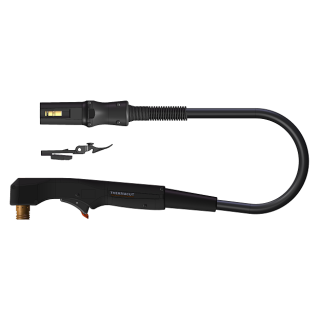
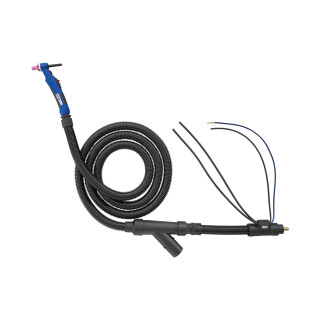
The torch construction is designed for precise current and air supply and for forming a narrow plasma flow. Inside, there are current-carrying parts, air supply channels, insulating elements, and a protective cap. All parts work together, so even slight wear affects cutting quality.
Modern plasma torches are selected according to the plasma cutter type, current strength, cable length, ignition method, and operating conditions. It is also important to consider consumable compatibility, because the electrode, nozzle, and cap must fit the specific model.
Main elements of a plasma torch
To understand the operating principle of a plasma torch, it is necessary to know the purpose of its main parts. They are responsible for arc ignition, air direction, protection of the working part, and cut stability.
The key elements of a plasma torch include:
- the electrode, which participates in arc formation;
- the nozzle, which compresses the plasma flow and defines the cut shape;
- the swirl ring, which directs airflow around the electrode;
- the protective cap, which protects the working part from damage;
- the body, which contains current-carrying and insulating elements;
- the handle, which provides comfortable holding of the torch;
- the cable-hose, through which current and compressed air are supplied;
- consumables, which are replaced as they wear out.
If the nozzle is damaged, the hole loses its shape, and the arc becomes wide and unstable. A worn electrode worsens ignition and reduces cut accuracy, so the condition of the parts must be checked before work.
Plasma torch cooling system
Cooling is necessary because a high temperature forms inside the torch. In low- and medium-power manual machines, air cooling is used more often. The airflow participates in plasma creation and at the same time, reduces the heating of the working part.
In more powerful systems, liquid cooling may be used. It removes heat effectively during long operation and high current. If cooling is insufficient, the electrode, nozzle, and protective cap overheat, and the service life of consumables decreases.
Types of plasma cutting
Plasma cutting can be manual or mechanized. The manual method is used in repair, installation work, small-scale production, and workshops. The operator guides the plasma torch along the cut line, controlling movement speed and distance to the metal.
Mechanized cutting is used on CNC machines. In this case, the torch moves along a set path, and the parameters are controlled by the control system. This method is suitable for serial cutting of sheet metal, complex contours, and repeatable parts.
Cutting also differs by working medium. Compressed air is most often used because it is available and suitable for most tasks. In industry, special gases may be used if it is necessary to improve edge quality or reduce oxidation.
What affects plasma torch quality and service life
Cut quality is affected by current strength, air pressure, movement speed, distance to the metal, and the condition of consumables. If the current is too low, the metal is cut poorly. If the current is too high, overheating increases, the nozzle wears out faster, and the heat-affected zone becomes larger.
Air preparation is also important. Moisture, oil, and contamination from the compressor worsen ionization, make the arc unstable, and accelerate electrode wear. Therefore, for plasma cutting, it is advisable to use clean, dry compressed air and monitor the filters.
The design and operating principle of a plasma torch show that cutting quality depends not only on machine power. Clean air, serviceable consumables, correct current, stable cooling, and accurate torch guidance are important. If these factors are controlled, the plasma torch lasts longer, and the edge is even and ready for further processing.