

-320x320.jpg "MIG/MAG Welding Machines")
-320x320.jpg "TIG AC/DC Welding Machines")




-320x320.jpg "Electrodes for High-Alloy Steel")
-320x320.jpg "Surfacing Electrodes")
-320x320.jpg "Electrodes for Cast Iron")








-320x320.jpg "Welding Masks")




-320x320.jpg "Welding Machine Carts")






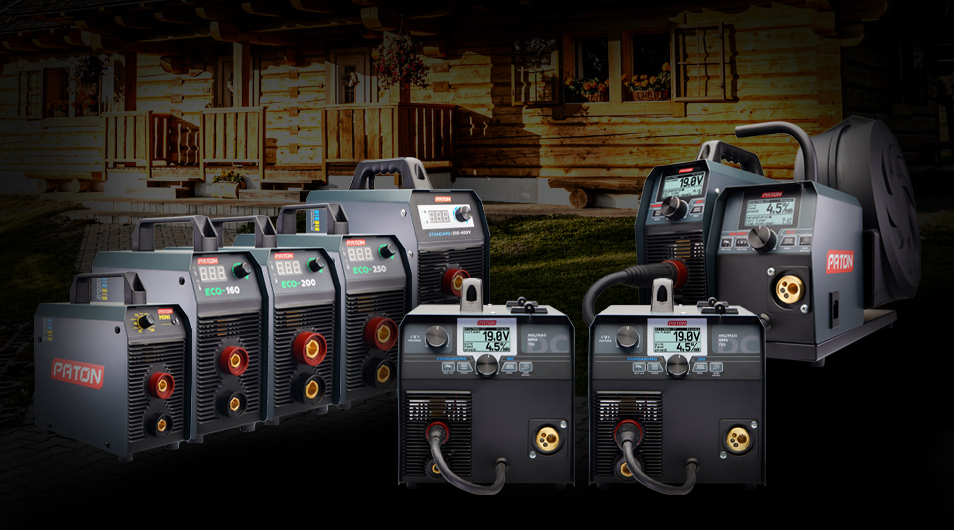
Ranking of welding machines for a summer house: 7 best models
Published:
27/04/2026
Choosing a welding machine for a summer house is more difficult than it seems at first glance. On a property, not only current and power matter, but also operation from a standard 220/230 V network, resistance to voltage drops, ease of carrying, cable length, a proper holder, a reliable ground clamp, and basic protection functions. For a summer house, people more often choose an inverter rather than a heavy transformer, because it is more compact, more convenient in everyday use, and better suited for occasional household work.
The ranking below is not based on price, but on real summer house scenarios: minor repair of a fence and gates, welding a wicket, a canopy, profile pipe, a barrel, a greenhouse, or utility structures. In short, how to choose a welding machine for a summer house depends on two things: how often you are going to weld and whether you need only electrode welding or also semi-automatic wire welding.
What you need to pay attention to when choosing
Before choosing a welding machine for a summer house, it is important to look not only at the series name. For a plot, stable work from a household power network, simple adjustment, moderate weight, current reserve, and functions that help ignite the arc more easily and prevent the electrode from sticking are usually more important. If work from a generator is planned, the generator itself must also have a power reserve, otherwise the machine will not show its full potential.
Type of machine
For a summer house, the choice is most often between an MMA inverter and a semi-automatic machine. If you need the simplest and most mobile welding machine for a summer house, it is more logical to look at welding inverters. This option is easier to carry around the property, simpler in terms of equipment, and does not require a gas cylinder. If faster welds, work with thin metal, and neat wire feed are more important, then it is worth looking at semi-automatic welding machines.
For seasonal summer house jobs, MMA almost always turns out to be the most practical start. A semi-automatic machine is more convenient where you weld more often, want a cleaner weld, and are ready to keep a cylinder, regulator, and consumables on hand. That is why it is easier to choose a welding machine for a summer house if you first honestly define the scope of work and only then move on to the model.
Current and power from the mains
For a summer house, a range of 140–200 A is usually enough, especially when it comes to a fence, gates, a frame, pipe, angle iron, and other everyday tasks. If the metal is thicker and a reserve for a 5 mm electrode is needed, then it makes sense to look at 200–250 A. At the same time, it is important not to choose a machine exactly at the limit of its capabilities, because a current reserve makes work calmer and reduces the load on the power network.
The second important point is the mains. For a plot, models that can tolerate voltage fluctuations and do not require perfectly stable power are especially valuable. In PATON household lines ECO, MINI, and in the StandardMIG and ProMIG semi-automatic machines, wide input voltage ranges are declared. If a generator is planned for the summer house, its power should be chosen with a reserve.
Ranking of welding machines for a summer house
Below are seven models that make sense specifically for a summer house. The ranking includes both simple MMA machines and semi-automatic machines for those who need a more universal set for different types of work.
PATON ECO-160
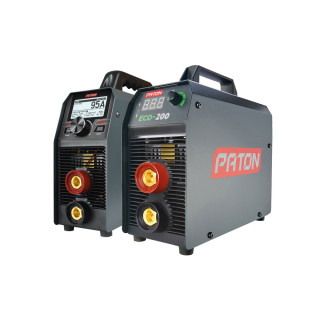
For basic summer house tasks, PATON ECO-160 remains a good starting point. This is a compact 160 A MMA inverter operating from a 220/230 V mains supply, with an input voltage range of 170–260 V, support for 1.6–4.0 mm electrodes, and a weight of 3.7 kg. For a summer house, this machine is convenient because it is easy to carry around the property, connect to a regular power network, and use for most minor repairs.
Pros
The main advantage of this model is that it is a really convenient welding machine for a summer house without unnecessary complexity. It has automatic Hot-Start, Arc-Force, and Anti-Stick functions, and its power is enough for typical household jobs where a reliable weld is needed but constant welding of thick metal is not required.
Cons
The limitation of ECO-160 is that it is not an option for a large current reserve. If you plan to weld massive parts often, work for a long time without pauses, or confidently use a large electrode, it is better to look at the next positions in the ranking.
PATON ECO-200
If a more universal machine is needed, it is worth looking at PATON ECO-200. The model is designed for 200 A, works from 220/230 V, handles a mains range of 170–260 V, supports 1.6–5 mm electrodes, and weighs about 4 kg. This is already a more confident choice if, in addition to minor repairs, there are gates, frames, posts, embedded parts, and more serious structures at the summer house.
Pros
ECO-200 has a good balance between weight, current reserve, and mains requirements. For a summer house owner, this is one of the most logical models, because the machine still remains mobile, but already gives more freedom in terms of metal thickness and electrode choice.
Cons
Compared to a semi-automatic machine, this still remains manual work with an electrode. For thin sheet, neat long welds, and frequent bodywork tasks, this format is less convenient than MIG/MAG.
PATON ECO-250
For those who need a reserve aimed at heavier work, PATON ECO-250 is suitable. The model has a nominal current of 250 A, support for 1.6–5 mm electrodes, operation from a 220/230 V mains supply, a voltage tolerance of 170–260 V, and a weight of 4.35 kg. This is already a machine with a noticeable reserve if on the plot you build something more serious than simply repairing a wicket.
Pros
ECO-250 provides the reserve that is often lacking in the younger models. If you need to weld thicker metal, work on more than just small repairs, and still have a compact inverter, this model looks very convincing.
Cons
For rare household tasks, such a reserve may turn out to be excessive. If you weld only a few times a season, there is no point in overpaying for power that you will hardly use.
PATON MINI-С
If compactness is the top priority, it is worth paying attention to PATON MINI-С. In the official line, MINI-С is presented as a compact MMA machine in a case, with a nominal current of 150 A, a mains range of 170–260 V, operation with 1.6–4 mm electrodes, and a nominal power of 4 kVA. For small summer house tasks, this is one of the most convenient models in terms of carrying and storage.
Pros
The main advantage of MINI-С is mobility. Such a welding machine for a summer house is convenient to store, transport in a car trunk, take to the property, to a garage, or on the road. If you need a neat home kit with a case, this model is very successful.
Cons
In terms of power reserve, MINI-С is inferior to ECO-200 and ECO-250. This is a choice rather for light and medium jobs, not for constant load and not for the thickest metal.
PATON StandardMIG-160
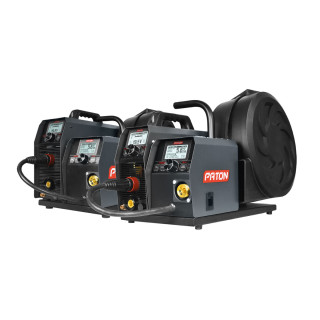
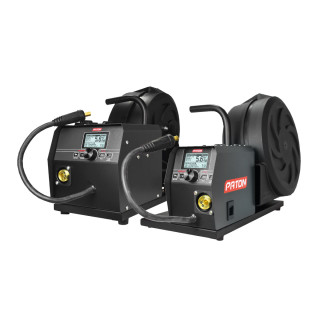
If you want a semi-automatic machine for a summer house, the first reasonable step will be PATON StandardMIG-160. The model is designed for 160 A, handles a mains range of 160–260 V, works with 0.6–1.0 mm wire, supports 1.6–4 mm electrodes, a spool up to 5 kg, and has synergic control in pulse mode.
Pros
For a summer house, this is a good option if you often weld thin metal, want a neat weld, and do not want to work with an electrode all the time. The model has adjustable Hot-Start and Arc-Force functions, automatic Anti-Stick, and a solid set of features for MIG/MAG, MMA, and TIG.
Cons
The drawback is obvious for a summer house: a semi-automatic machine requires more equipment. You need wire, a gas cylinder, a regulator, and the machine itself is heavier and less mobile than a regular MMA inverter.
PATON StandardMIG-200
The next step is PATON StandardMIG-200. Here there are already 200 A, an input voltage range of 160–260 V, 0.6–1.0 mm wire, 1.6–5 mm electrodes, a spool up to 5 kg, and the same set of adjustable functions with PULSE MIG/MAG/MMA/TIG. For a summer house, this is a variant not just to try a semi-automatic machine, but to realistically cover a wide range of tasks with one machine.
Pros
StandardMIG-200 is good because it combines the convenience of a semi-automatic machine with a solid current reserve. If you want to choose a welding machine for a summer house not only for seasonal repairs but also for a serious home workshop, this model looks very strong.
Cons
For occasional summer house welding, the model may be excessive in capabilities, budget, and the overall set of surrounding equipment. Such a machine reveals itself better where it is used regularly.
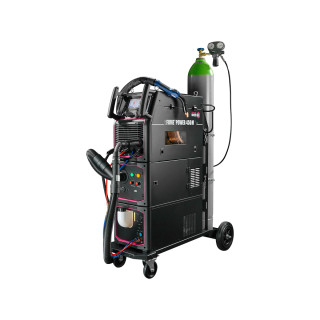
PATON ProMIG-200-15-2
The most universal and strongest option in this ranking looks to be PATON ProMIG-200-15-2. It has 200 A nominal current, a 70% duty cycle at nominal current, a working mains range of 160–260 V, welding voltage adjustment of 12–26 V, support for 0.6–1.0 mm wire, 1.6–5.0 mm electrodes, a PULSE function, and adaptive cooling.
Pros
The main advantage of ProMIG-200-15-2 is its reserve in terms of service life and universality. If there is a full workshop at the summer house, you weld often, work with different metals, and want a machine not to try, but for a long period, this is the strongest position in the ranking.
Cons
For an ordinary summer house without constant welding, this is more of a professional scenario than simply a household one. The machine is heavier, more expensive, and requires a more thoughtful approach to setup, equipment, and storage.
If you need the simplest and most mobile welding machine for a summer house, it is better to look at MINI-С, ECO-160, or ECO-200. If you want a power reserve, take ECO-250. If the priority is a neat weld, thin metal, and the convenience of working with wire, then it is more logical to choose StandardMIG-160, StandardMIG-200, or ProMIG-200-15-2. In the end, the easiest way to choose a welding machine for a summer house is by one rule: for occasional work an MMA inverter is better, and for frequent and more universal welding a semi-automatic machine is better.