

-320x320.jpg "MIG/MAG Welding Machines")
-320x320.jpg "TIG AC/DC Welding Machines")




-320x320.jpg "Electrodes for High-Alloy Steel")
-320x320.jpg "Surfacing Electrodes")
-320x320.jpg "Electrodes for Cast Iron")









-320x320.jpg "Welding Masks")




-320x320.jpg "Welding Machine Carts")








Tungsten electrode sharpening rules
Published:
20/07/2026
Tungsten electrode sharpening directly affects TIG welding stability, arc shape, and weld quality. If the tip is prepared incorrectly, the welding arc begins to wander, penetration becomes unstable, and the weld pool is harder to control. That is why it is important to understand how to sharpen a tungsten electrode correctly before work.
A tungsten electrode does not melt like filler metal, but its shape defines the direction of the arc. Ignition, heat concentration, penetration depth, and joint cleanliness depend on grinding quality. This is especially important for argon arc welding, because the process requires precision and careful pool control.
Why proper tungsten electrode sharpening is important
Proper electrode sharpening helps achieve a stable and directed arc. When the grinding cone is even, the arc is concentrated at the required point, and the metal heats predictably. This simplifies work with thin parts, stainless steel, aluminum, and other materials.
If tungsten is sharpened unevenly, the arc may drift to the side. As a result, the weld becomes less neat, the risk of edge overheating increases, and the welder spends more time correcting movement. The risk of contaminating the pool with electrode particles also increases.
For stable work, not only the machine and torch are important, but also consumables. High-quality welding electrodes help achieve reliable ignition, a stable arc, and a clean result in different TIG modes.
How to sharpen a tungsten electrode correctly
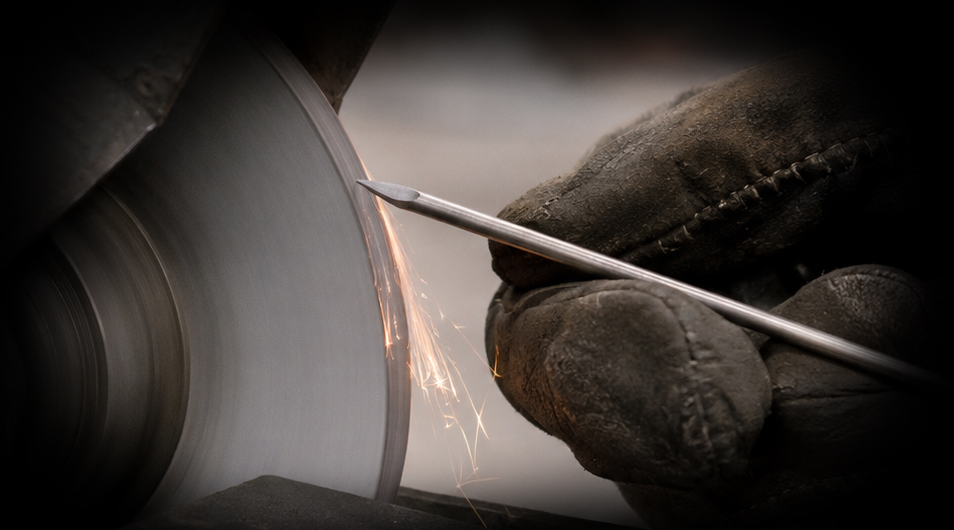
To understand how to sharpen a tungsten electrode correctly, the grinding direction must be considered. For TIG, longitudinal grinding is used, where the marks run along the electrode axis. This grinding direction guides the arc forward and makes it more stable.
Transverse grinding is undesirable because the marks cross the current direction and may cause the arc to deflect. It is better to sharpen the electrode on a separate abrasive wheel that is not used for steel or other metals. This reduces the risk of tungsten contamination.
Before work, the electrode is fixed in an electrode holder or a special device and carefully brought to the abrasive. It is important not to overheat the metal and not to press too hard. After grinding, the tip should be even, without chips, deep grooves, or an uneven edge.
The main sharpening rules are:
- sharpen the electrode only along the axis;
- use a clean abrasive without traces of other metals;
- do not overheat tungsten during grinding;
- keep the same sharpening angle around the full circumference;
- make a slight flat at the tip if necessary;
- remove the damaged section after touching the pool.
Such preparation helps maintain arc stability and reduce the risk of defects. It is especially important to follow these rules when welding thin metal, where even a slight arc deviation noticeably affects the weld.
How the sharpening angle affects welding
The sharpening angle determines how narrow or wide the welding arc will be. A sharp cone gives a more concentrated arc and helps work with low current. This is convenient for thin metal, precise welds, and areas where heat input must be limited.
A blunter angle makes the arc wider and more stable at higher current. This option is used for thick parts when deep penetration and a stable weld pool are required. However, an angle that is too large may reduce arc control at low current.
A slight flat at the electrode tip helps reduce the risk of the point melting. It is especially useful when working at high current. If the tip is too sharp, it overheats faster, loses its shape, and may contaminate the pool.
When choosing the shape, current type, electrode diameter, material, and welding mode must be considered. For DC TIG, a pointed cone is used more often. For some AC modes, the shape may differ because the electrode works under different heating conditions.
Mistakes when sharpening a tungsten electrode
One common mistake is transverse grinding. With this type of grinding, the arc becomes less controllable, and ignition may worsen. Another problem is using a dirty wheel that was previously used for steel, copper, or aluminum.
Chips and deep scratches must not be left on the working end. They disrupt the direction of the arc and worsen weld quality. The electrode should also not be overheated during sharpening, because this may change the surface condition and reduce arc stability.
A very long thin cone is also considered a mistake. It overheats quickly, especially at high current. If the cone is too short and rough, the arc becomes wide, and work accuracy decreases. Therefore, tungsten electrode sharpening must match the specific task.
When the electrode should be reground or replaced
The electrode should be reground if it touches the weld pool, filler metal, or base metal. After such contact, contamination appears on the tip and interferes with a stable arc. Continuing work without regrinding is not recommended, because the defect will quickly transfer into the weld.
Regrinding is also needed if the grinding cone has melted, become uneven, or changed shape. Signs of a problem may include arc wandering, difficult ignition, black inclusions in the weld, unstable penetration, and poorer pool control.
It is better to replace the electrode if it has become too short, has cracks, severe chips, or does not fix properly in the collet. In this case, even correct grinding will not ensure reliable operation. A serviceable tungsten electrode must be firmly held in the torch and maintain its shape during welding.
Summary
Tungsten electrode sharpening helps achieve a stable arc, precise penetration, and a clean weld pool during TIG welding. If you know how to sharpen a tungsten electrode correctly, follow longitudinal grinding, control the angle, and regrind the tip on time, argon arc welding quality will remain stable.