

-320x320.jpg "MIG/MAG Welding Machines")
-320x320.jpg "TIG AC/DC Welding Machines")




-320x320.jpg "Electrodes for High-Alloy Steel")
-320x320.jpg "Surfacing Electrodes")
-320x320.jpg "Electrodes for Cast Iron")








-320x320.jpg "Welding Masks")




-320x320.jpg "Welding Machine Carts")






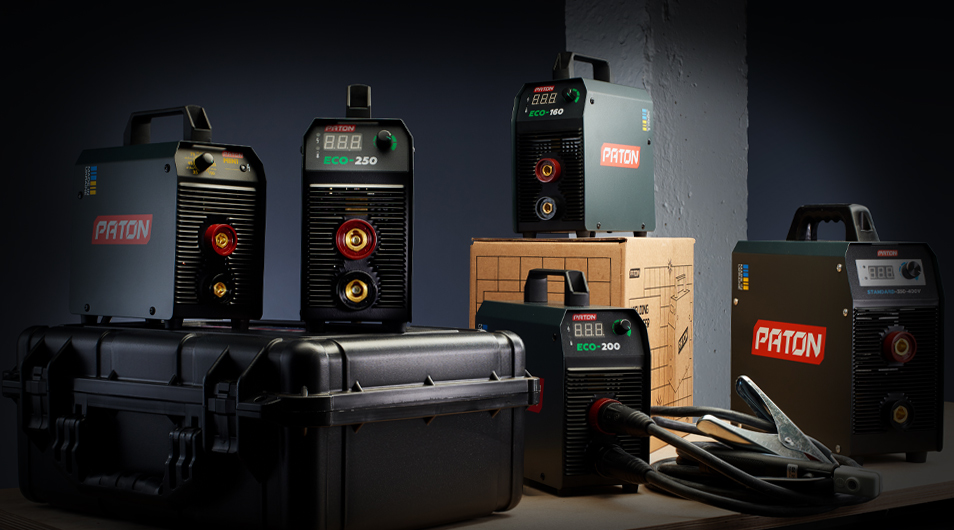
Best welding machines for home use
Published:
20/07/2026
The best welding machines for home use are chosen not only by maximum current. For a garage, country house, or workshop, it is more important to understand which tasks the machine will perform most often. For repairing a fence, gate, canopy, or frames, an MMA inverter is usually suitable, while for thin metal and long welds, a semi-automatic machine is more convenient.
Good welding for home use should work stably from a household power supply, be easy to set up, and not create unnecessary maintenance difficulties. If you understand how to choose a good welding machine for home use, it is easier to select a model for the electrode, wire, metal thickness, mains voltage, and mobility.
How to choose a welding machine for home use
First, it is worth determining the main process. An MMA inverter works with a stick electrode and is suitable for repairing metal structures, installation, garage work, and country house tasks. A MIG/MAG semi-automatic machine uses welding wire, so it is better suited for thin metal, neat welds, and regular work in a workshop.
For home use, it is important to consider a 220/230 V network and possible voltage drops. If the wiring is old or the machine is often connected through an extension cable, you need to look at energy consumption, arc stability, and power supply requirements.
Before buying, evaluate the main parameters:
- welding type: MMA for electrode or MIG/MAG for wire;
- welding current range and power reserve;
- stable operation during mains voltage drops;
- availability of hot start, anti-stick, and arc force functions;
- weight, compactness, mobility, and ease of storage;
- metal thickness you will work with most often;
- availability of electrodes, wire, and other consumables.
For occasional household tasks, a simple inverter is often enough. If the work is performed regularly, it is better to choose a machine with a current reserve. For thin parts, a semi-automatic machine is a good solution.
Top 7 best models
The selection includes PATON models for home tasks, garages, country houses, and small workshops. There are compact machines for beginners, more powerful MMA inverters, and semi-automatic machines for working with wire. The best welding machine for home use depends on metal thickness, welder experience, and frequency of use.
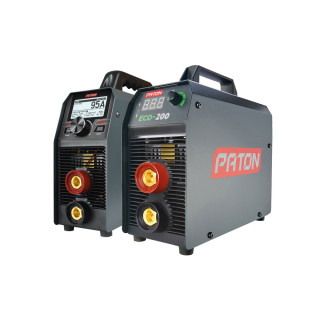
PATON ECO-250
PATON ECO-250 is a powerful MMA inverter for home, garage, and workshop use. It is chosen when a welding current reserve and the ability to work with thicker workpieces are needed. The model is suitable for repairing gates, frames, canopies, fences, and other structures where confident penetration is important.
The machine is designed for working with stick electrodes. With correct setup, it provides a stable welding arc and helps perform more than minor repairs.
Advantages
PATON ECO-250 has a good current reserve, works with common electrodes, and is suitable for different household tasks. The hot start function makes ignition easier, while the stable arc helps produce a quality weld. The machine is suitable for those who want a model not only for occasional repair, but also for regular work.
Disadvantages
For simple repair of thin metal, the ECO-250 may be excessive. When working at high current, it is important to consider the condition of the power supply, extension cable quality, and wiring load. If the tasks are small and irregular, a compact inverter can be chosen.
PATON ECO-160
PATON ECO-160 is a practical inverter for home, country house, and garage use. It is suitable for those looking for good welding for home use without complicated setup or extra weight. The model is used for repairing hinges, fences, brackets, small frames, and other household parts.
The ECO-160 is convenient for beginners. The machine is easy to control, takes up little space, and is suitable for periodic use.
Advantages
The main advantages of the model are compactness, mobility, and simple control. The machine is convenient to carry, store, and connect at home. It is suitable for common electrodes and helps quickly perform repair work without complicated preparation.
Disadvantages
The welding current reserve is lower than that of the ECO-250. For thick workpieces, long passes, and intensive work, the capabilities may be insufficient. If regular heavy-duty tasks are planned, it is better to choose a more powerful model.
PATON MINI
PATON MINI is a compact welding machine for simple home work. It is suitable for users who value low weight, mobility, and quick start-up. Such an inverter is convenient to keep in the garage, take to a country house, or use for small repairs.
The model is designed for MMA welding with a stick electrode. PATON MINI can be considered as a first machine for training and basic tasks where high welding current is not required.
Advantages
PATON MINI is light, simple, and easy to store. It is quickly ready for work, takes up little space, and is suitable for small joints. This is a practical solution for occasional repair and training.
Disadvantages
The model is not designed for long welding of thick metal. The power reserve is limited, so for serious structures it is better to choose the ECO-160 or ECO-250. It is also important to select the electrode diameter correctly.
PATON MINI-C
PATON MINI-C is a compact version for home, garage, and on-site work. The machine is convenient when storage, carrying, and simple preparation for welding are important. It can be used for periodic repair, small joints, and training.
Like the basic version, the MINI-C is intended for MMA welding and household tasks without high load.
Advantages
The main advantage of the MINI-C is compactness and easy transportation. The machine is easy to place in a garage or take to a site. It is suitable for simple repair and helps complete work quickly where high power is not required.
Disadvantages
In terms of capabilities, the MINI-C is below more powerful models. For larger electrode diameters, long welds, and thick workpieces, it is better to choose a machine with a larger current reserve. It is important not to use the model for tasks it is not designed for.
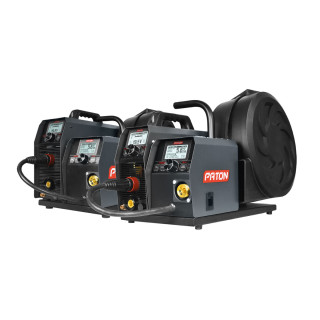
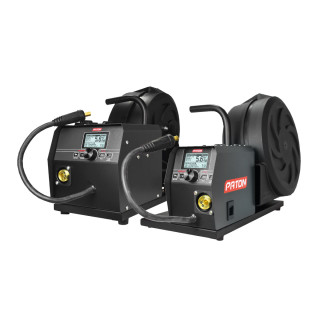
PATON StandardMIG-200
PATON StandardMIG-200 is a semi-automatic machine for users who need neat wire welding. It is suitable for garages, workshops, bodywork, frames, gates, and parts made of sheet or profile metal.
A semi-automatic machine is convenient because welding wire is fed automatically. It is easier for the welder to guide a long weld and control the pool with the correct choice of gas, wire, and mode.
Advantages
StandardMIG-200 combines versatility, clear setup, and good productivity for a home workshop. It is convenient for thin metal, long joints, and regular work. The machine helps reduce spatter and the amount of cleaning after welding.
Disadvantages
MIG/MAG requires gas, wire, and consumables. Preparation is more complicated than with an MMA inverter. If the machine is needed only for occasional repairs at a country house, a semi-automatic machine may be more functional than necessary.
PATON EuroMIG
PATON EuroMIG is a semi-automatic machine for a home workshop, repair, and work with thin metal. It is suitable for those who want to master MIG/MAG and achieve a neat weld compared with electrode welding.
EuroMIG is convenient where speed, accuracy, and weld pool control are important. It is used for sheet metal, profiles, and garage repair.
Advantages
The model is convenient for thin metal and household tasks. Automatic wire feeding simplifies long welds, and mode adjustment helps achieve a stable arc. For home use, this is a good balance of compactness and capabilities.
Disadvantages
For thick metal and high load, the capabilities may be insufficient. It is also necessary to monitor gas, torch condition, rollers, and feed channel. For more difficult work, it is better to consider the StandardMIG-200.
PATON StandardMIG-160
PATON StandardMIG-160 is a semi-automatic machine for home and semi-professional tasks. It is suitable for repair, bodywork elements, thin metal, small structures, and a workshop. The model is chosen by those who need MIG/MAG welding without a large current reserve.
StandardMIG-160 helps work with wire and achieve a neat weld with correct setup. This is a convenient option for switching from electrode welding to welding in shielding gas.
Advantages
The machine is suitable for thin metal, regular repair, and long joints. It makes the process convenient, reduces the amount of cleaning, and helps achieve a stable arc. For a garage and small workshop, this is a practical solution.
Disadvantages
For thick workpieces and long high-load operation, it is better to choose the StandardMIG-200 or a more powerful semi-automatic machine. The machine also requires gas, wire, and consumable maintenance, like other MIG/MAG models.
Which welding machine to choose for home tasks
If you need a first machine for home, country house, and simple repair, it is worth considering PATON MINI, MINI-C, or ECO-160. They are compact, easy to understand, and suitable for MMA welding. This option is convenient if the main work is performed with an electrode, and simple setup and mobility are important.
If more power is needed for gates, canopies, frames, and regular tasks, it is better to choose PATON ECO-250. It provides a current reserve and helps achieve confident penetration on thicker metal.
If thin metal, a neat weld, and work with wire are priorities, it is worth looking at semi-automatic machines. EuroMIG is suitable for a compact workshop, StandardMIG-160 for regular home work, and StandardMIG-200 for more universal use.
To understand how to choose a good welding machine for home use, focus on real tasks. An inverter is needed for an electrode, while a semi-automatic machine is needed for wire. For a garage, mobility and simple setup are important, while for a workshop, productivity and current reserve matter.
Summary
The best welding machine for home use is a model that matches your tasks, power supply, metal thickness, and work experience. Good welding for home use is achieved when the inverter or semi-automatic machine is correctly selected, set up, and used with a suitable electrode or wire.