

-320x320.jpg "MIG/MAG Welding Machines")
-320x320.jpg "TIG AC/DC Welding Machines")




-320x320.jpg "Electrodes for High-Alloy Steel")
-320x320.jpg "Surfacing Electrodes")
-320x320.jpg "Electrodes for Cast Iron")








-320x320.jpg "Welding Masks")




-320x320.jpg "Welding Machine Carts")






Submerged Arc Welding: Advantages, Features and Applications
Published:
27/04/2026
Submerged arc welding belongs to industrial metal joining technologies where high productivity, deep penetration, and stable weld quality are especially important. This method is used in the manufacture of tanks, pipes, beams, housings, and other critical structures. It is rarely used in household conditions, but in production it remains one of the most effective solutions.
Interest in the topic is understandable, because what submerged arc welding is is most often asked where a long weld, good tightness, and a reliable joint on thick metal are required. That is why SAW-welding is widely used in mechanical engineering, shipbuilding, and metal structure production. Where repeatability of results, strength, and process stability are important, this technology often proves to be more effective than manual methods.
What is submerged arc welding
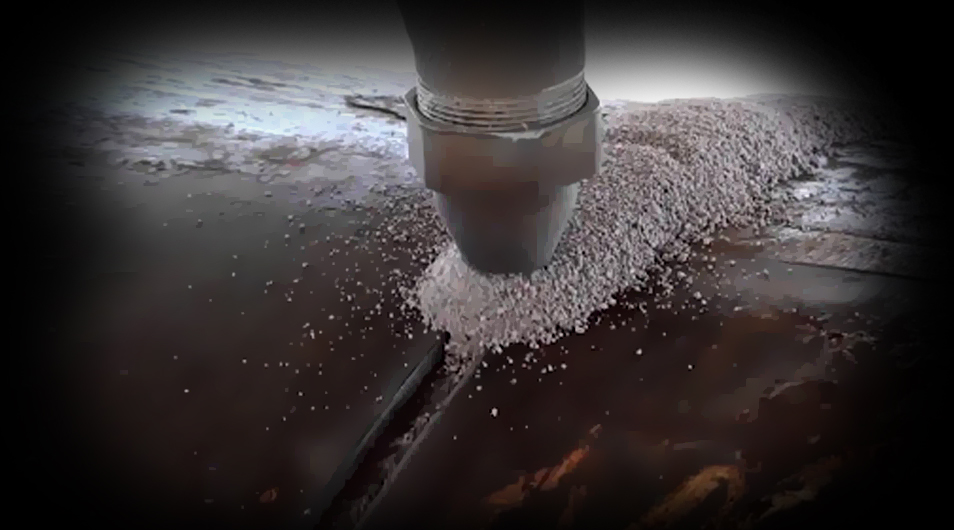
Simply put, submerged arc welding is a process in which the arc burns between the metal and a continuously fed wire, while the welding zone itself is covered by a layer of flux. During operation, the flux isolates the weld pool from air, helps maintain arc stability, and forms protective slag above the weld. Because of this, the metal has less contact with the external environment, and the joint becomes more reliable.
At the same time, it is important to understand that the key role here is played by the flux layer itself. It not only covers the welding area, but also affects weld formation, reduces the risk of defects, and helps achieve a more even result. In the classic SAW process, solid wire and a separate flux fed above the arc zone are usually used.
If the technologies are compared, then flux-cored wire belongs to a different operating principle where protective components are located inside the wire itself. In submerged arc welding, protection is created by an external layer of material covering the arc and the weld pool. This makes the process less dependent on the external environment and especially convenient for long, repetitive passes.
The principle of submerged arc welding
The principle of the process is based on continuous wire feeding into the joint area and simultaneous flux feeding ahead of the arc. The arc burns under the flux layer, melts the metal edges and filler material, and the weld pool remains closed off from the air. Part of the flux melts and turns into slag, which additionally protects the weld during formation.
Because of this arrangement, the arc works evenly, metal transfer is stable, and the weld receives good penetration. The process is especially convenient where long passes without frequent stops and repeatable results along the full length of the joint are needed. That is why SAW-welding combines well with mechanization and automation.
Another important detail is that the flux layer helps retain heat in the joint area. This has a positive effect on weld pool formation, penetration depth, and the overall character of the weld. As a result, the technology is well suited for thick metal, where a regular manual arc often proves less productive.
Advantages of submerged arc welding
The main advantage of this technology is high productivity. Thanks to continuous wire feeding and a stable arc, large volumes can be completed faster than with many manual processes. This is especially important on long welds and on thick metal.
The second advantage is related to joint quality. Flux protects the pool, reduces the influence of air, and helps achieve deep penetration. As a result, the weld becomes dense, strong, and more uniform. This is especially important for critical products, because tightness, strength, and stable parameters along the full weld length are valued here.
It is also worth noting reduced spatter and ease of automation. Since the arc works under a layer of flux, spatter is less pronounced and the process is easier to transfer to equipment. That is why production tasks often also consider welding equipment as part of a complete solution for a specific technology.
An additional advantage is the reduced influence of the human factor. When the process is mechanized, it is easier to maintain the same speed, the same wire feed, and a stable mode along the full length of the joint. This is especially important in serial production, where every deviation affects batch quality and the overall pace of work.
Features of weld formation in submerged arc welding
In this technology, the weld is formed under a slag layer created from molten flux. Because of this, the weld pool is protected, the arc remains stable, and the metal cools in a more controlled way. With correct mode selection, the weld becomes dense, even, and well penetrated.
The weld shape is influenced by current, wire feed speed, travel speed, flux properties, and metal thickness. If the parameters are chosen correctly, the joint becomes strong and uniform, and the weld geometry remains stable. If the mode is disturbed, incomplete penetration, excessive reinforcement, or surface defects may appear.
It is also important that in submerged arc welding a separate shielding gas is usually not needed, because this function is taken over by the flux itself and the slag that forms. This makes the process especially convenient in production conditions where stability and high productivity are required.
Subsequent cleaning is also important. After the pass is completed, the slag must be removed to assess the appearance of the joint and make sure the weld formed correctly. That is why the technology gives a good result when the process is organized properly and the mode, edge preparation, and consumable control are all maintained.
Technology limitations
Despite its clear advantages, submerged arc welding is not suitable for every task. Most often it is used in the flat position or in conditions where the flux layer can be held above the weld zone. This limits the use of the technology in installation work, overhead repairs, and household scenarios where versatility is important.
Another limitation is connected with the application area. For thin metal, short local joints, and small repairs, this technology often turns out to be excessive. Its strengths are revealed where there are large workpieces, long welds, and a stable production cycle. It is also important to take into account flux condition, correct mode setup, and later slag removal after welding.
The requirements for work organization must also be considered. For SAW, it is not enough just to feed wire and switch on the arc. It is important to prepare the metal properly, choose the flux, ensure stable feeding, and understand in advance what type of joint the mode is selected for. That is why the technology shows its full potential in production rather than in occasional household use.
Submerged arc welding is a technology that combines high productivity, stability, and the ability to obtain a high-quality joint on thick metal. If answered briefly, what submerged arc welding is is a way to obtain a strong, tight, and even weld under flux protection where penetration, repeatability of results, and industrial efficiency are especially important.