

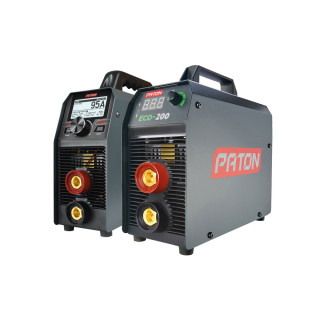
-320x320.jpg "MIG/MAG Welding Machines")
-320x320.jpg "TIG AC/DC Welding Machines")
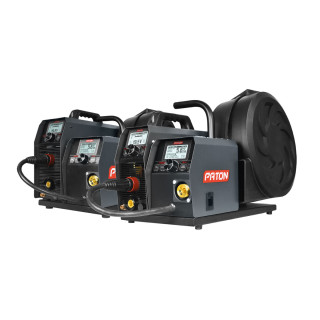
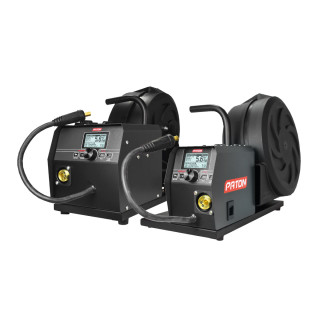




-320x320.jpg "Electrodes for High-Alloy Steel")
-320x320.jpg "Surfacing Electrodes")
-320x320.jpg "Electrodes for Cast Iron")








-320x320.jpg "Welding Masks")




-320x320.jpg "Welding Machine Carts")






How to Weld Aluminum?
Published:
24/04/2026
Welding aluminum requires strict adherence to the technology and precise equipment setup. To understand how to weld aluminum and how to weld aluminum without defects, it is necessary to take into account its physical properties, including high thermal conductivity, a tendency to form an oxide film, and sensitivity to contamination. Unlike steel, aluminum removes heat from the welding zone much faster, which makes it more difficult to maintain a stable arc and heat the edge evenly.
Aluminum welding is widely used in construction, mechanical engineering, repair work, and the production of metal structures. Due to its light weight and corrosion resistance, aluminum is extensively used in various industries. However, if the welding technology is incorrect, defects such as porosity, cracks, a weak weld, and deformation may occur. That is why it is important to choose the right equipment and mode, as well as ensure high quality surface cleaning before starting work.
Why aluminum is difficult to weld
The main difficulty lies in the presence of an oxide film. Aluminum oxide forms on the surface almost instantly and has a melting temperature significantly higher than the metal itself. This interferes with the formation of the weld pool and worsens the quality of the joint.
The second important feature is high thermal conductivity. Aluminum quickly removes heat from the arc zone, so higher energy input and precise mode adjustment are required. Without this, it is difficult to achieve uniform penetration.
Another problem is the tendency toward porosity. If dirt, moisture, or oil is present, gases are released during heating, enter the molten metal, and create defects inside the weld. This reduces the strength of the joint.
Aluminum also has high fluidity. In its molten state, the metal spreads easily, so it is necessary to control the weld pool, travel speed, and electrode position. Overheating leads to deformation, while insufficient heating causes lack of fusion.
In addition, it should be taken into account that aluminum is sensitive to mode fluctuations. Even small deviations in current, voltage, or gas supply can significantly affect the result.
Main methods of aluminum welding
Aluminum can be welded using several methods, but the most common are TIG and MIG/MAG. Each of them has its own characteristics and is used depending on the task.
TIG
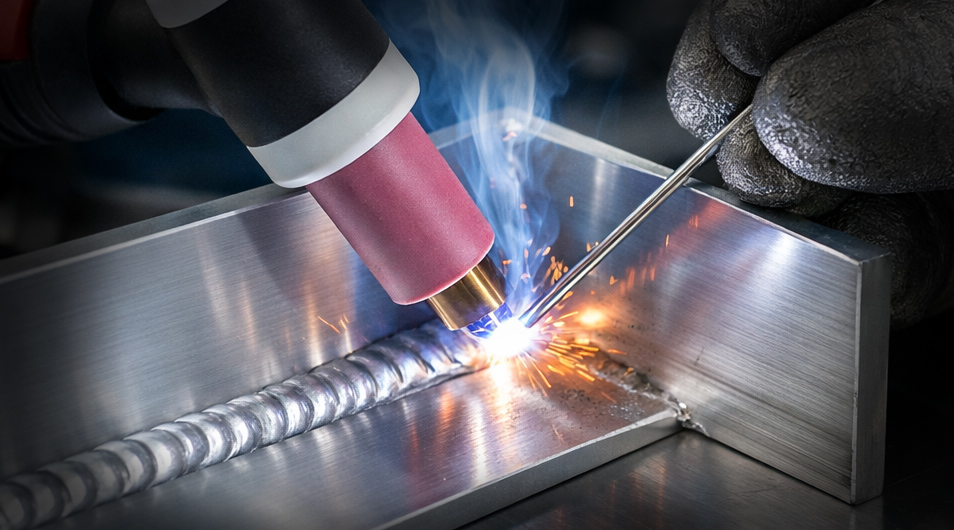
TIG welding is considered the most precise method. The process uses a non-consumable electrode and a shielding gas, argon or an argon-helium mixture.
The TIG method allows maximum control over the arc and the weld pool. This is especially important when working with thin metals and critical structures. This method ensures a clean and neat weld without spatter.
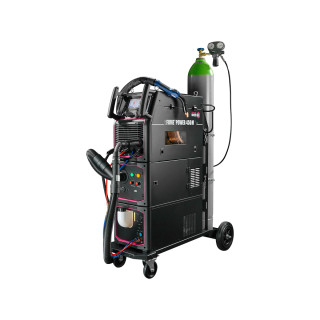
For such work, TIG welding machines are used, allowing precise parameter adjustment and ensuring stable equipment operation.
MIG/MAG
Semi-automatic welding is used when working with thicker parts and when high productivity is required. The process uses aluminum wire, which is fed automatically.
When considering how to weld aluminum with a semi-automatic machine, it is important to ensure stable wire feeding, the correct mode, and sufficient gas shielding. Incorrect adjustment may lead to spatter, an unstable arc, and poor weld formation.
For such tasks, welding semi-automatic machines are used, allowing precise parameter control and ensuring stable metal transfer.
Preparation for welding
Before welding aluminum, it is necessary to prepare the material carefully. This is one of the key stages on which the quality of the joint directly depends.
Before starting work, the following steps must be completed:
- remove all contaminants, including oil, dust, and moisture;
- mechanically clean the surface from the oxide layer;
- prepare the edge for uniform penetration;
- select filler material or wire according to the alloy type;
- check the equipment and set the welding mode.
After cleaning, it is important to begin work immediately, since the oxide forms again very quickly. It is also recommended to use separate tools for aluminum in order to avoid contamination.
Special recommendations for aluminum welding
Even with proper preparation, it is important to consider additional nuances that affect the result.
MIG welding
When working with a semi-automatic machine, the key factor is stable wire feeding. Aluminum wire is soft, so wire feeding problems may occur, leading to an unstable arc.
The welding speed must be selected correctly. At a low speed, heat input increases and deformation occurs, while at a high speed, penetration worsens.
It is also important to control gas consumption. A lack of gas leads to oxidation, while an excessive amount may disrupt process stability.
In addition, the torch length and nozzle condition should be taken into account, since this affects gas delivery and weld formation.
TIG welding
This method requires high precision and control. The use of alternating current allows the oxide film to be broken down directly during the welding process.
During work, it is important to consider the following parameters:
- stable arc length;
- correct electrode position;
- uniform filler feeding;
- control of the weld pool temperature;
- surface cleanliness and absence of contamination.
It is also necessary to take into account the electrode diameter and current strength. An incorrect choice leads to an unstable arc and poorer joint quality.
In addition, it is important to control the weld shape. Excessive heat input causes the metal to sag, while insufficient heat input causes lack of fusion.
Aluminum welding requires precise preparation, the correct choice of method, and strict control of parameters, which makes it possible to obtain a strong, dense, and high quality weld without porosity, deformation, and other defects even under difficult working conditions.