

-320x320.jpg "MIG/MAG Welding Machines")
-320x320.jpg "TIG AC/DC Welding Machines")




-320x320.jpg "Electrodes for High-Alloy Steel")
-320x320.jpg "Surfacing Electrodes")
-320x320.jpg "Electrodes for Cast Iron")








-320x320.jpg "Welding Masks")




-320x320.jpg "Welding Machine Carts")






Features of Cast Iron Welding
Published:
27/04/2026
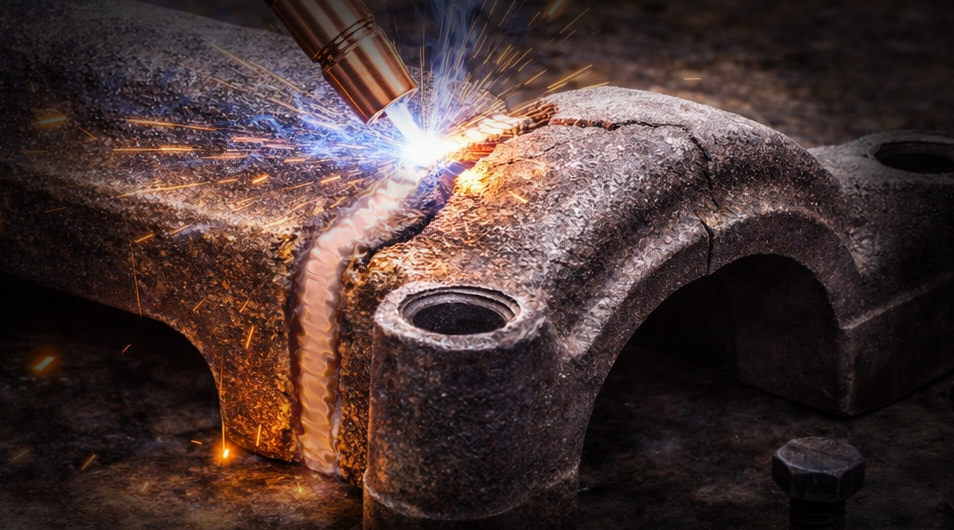
Cast iron is one of the materials that poorly tolerates rough heating and sharp temperature changes. It has high brittleness, graphite is present in its structure, and the metal itself is prone to crack formation in and near the weld zone. That is why the question of what to use to weld cast iron cannot be solved as simply as for ordinary steel. It is necessary to consider temperature, the heating method, future machining of the part, and acceptable deformation.
When people ask how to weld cast iron, they usually mean crack repair, edge restoration, or local build-up on a part. Here, not only the electrode and current are important, but also preheating, pass length, cooling, and proper preparation of the repair area. If the process is approached without taking these features into account, the weld may turn out brittle, and the part itself may crack again very quickly.
Why cast iron requires a special approach during welding
The main difficulty is that cast iron contains an increased amount of carbon and graphite inclusions. During local heating, the structure of the material changes, and after rapid cooling, hard and brittle areas may form in the weld zone. Because of this, the metal becomes sensitive to internal stresses, and the strength of the joint directly depends on how carefully the mode was selected.
In addition, cast iron tolerates sharp thermal shocks worse than steel. If the weld pool overheats and then the joint zone cools too quickly, the risk of cracks increases, post-repair machining becomes worse, and the probability that the weld will be uneven rises. That is why how to weld cast iron is always connected with temperature control and understanding which method is suitable for a specific part.
What methods of cast iron welding are used in practice
In practice, MMA is most often chosen for cast iron repair. This method remains the most common because it allows local work, the use of special electrodes, and more accurate heat control in small sections. Alternative methods are also used, but usually in narrower tasks and with more limitations. For such repairs, MMA welding is convenient.
Welding with an electrode (MMA)
If we talk about what to use to weld cast iron in household and repair conditions, special electrodes for MMA are most often used. This method is suitable for welding cracks, restoring seating surfaces, edges, and local defects. At the same time, the work is usually done in short beads with pauses so that the metal does not overheat and deformation does not increase.
When the question arises of how to weld cast iron with an electrode, it is important to remember the pass length and the intensity of heating. A weld that is too long in one go can lead to stress accumulation and the formation of new cracks. That is why MMA for cast iron is not about speed, but about careful control of the pool, temperature, and cooling between passes.
Alternative methods: MIG, TIG
Alternative methods are also possible, but they are used less often. If people ask how to weld cast iron with a semi-automatic machine, it usually means special wires, repair operations, or cases where build-up is needed rather than a classic structural joint. For such tasks, semi-automatic welding machines may be used, but the process itself requires very careful adjustment and is far from always considered the optimal solution for cast iron.
TIG is also used as an alternative, especially in delicate repairs and where more precise heat control is important. In such cases, argon welding may be used, but for cast iron this approach requires experience and correct filler selection. In practice, MMA still remains the more typical answer to the question of what to use to weld cast iron in repair work.
Cast iron welding by temperature mode
The choice of temperature mode determines almost the entire result. For cast iron, either cold welding with minimal heating or hot welding with serious preheating of the part and very slow cooling is used. This affects weld behavior, crack risk, and the final strength of the joint.
Cold welding of cast iron
Cold welding of cast iron is used more often, especially in local repair. Its essence is that general preheating is either not performed at all or is limited to minimal local heating, while the weld itself is laid in short sections. After each section, the metal is allowed to cool so as not to overheat the part and not to provoke new brittleness in the joint zone.
This approach is convenient for repair work when the part cannot be fully heated or when too high a temperature may damage the geometry. But the cold method requires patience, because how to weld cast iron in this mode is always about short passes, careful cooling, and crack control after each stage.
Hot welding of cast iron
Hot welding of cast iron is used for more critical cases when better joint quality is needed and the risk of brittle structures must be reduced. In this mode, the part or repair zone is preheated, and then after welding it cools slowly. In technical sources, the hot mode is usually associated with preheating to about 600–700°C followed by controlled cooling.
The advantage of this approach is that temperature differences become softer, and the weld and adjacent zone get more favorable conditions for formation. But the method itself is more difficult to perform, requires equipment, time, and strict adherence to the mode. That is why in household practice it is used less often than cold welding.
What electrodes are suitable for cast iron welding
When selecting consumables, the most important thing is to take into account the electrode composition and the repair task. Several options are used for cast iron:
- nickel electrodes for a more ductile weld and reduced crack risk;
- iron-nickel electrodes for repair of parts where better strength is needed;
- special cast iron electrodes for cold welding and local restoration;
- steel electrodes in some repair schemes, but usually with greater limitations in result quality.
Nickel is especially valued because it helps produce a more machinable weld and reduces the tendency to cracking. But the final choice depends on the grade of cast iron, the size of the defect, and whether mechanical machining of the part will be needed after repair.
Typical defects when welding this material
For cast iron, the most typical defects are cracks, pores, an overly hard weld, poor machinability, and local deformation. Problems usually appear because of overheating, passes that are too long, an unsuitable electrode, lack of preheating where it is needed, or overly sharp cooling after welding.
A separate difficulty is connected with the fact that the defect may appear not immediately, but after cooling. That is why cast iron must not be welded in a hurry. Pauses, temperature control, a careful weld, and understanding how a specific part behaves after heating are all important here.
How to prepare cast iron for welding
Preparation of the part before repair should be consistent:
- Clean the surface from oil, dirt, paint, and corrosion products.
- Open the crack or defect so as to ensure access to the weld root.
- Stop the crack end if this is required by the nature of the damage.
- Choose the mode, the electrode, and decide whether preheating is needed.
- Prepare the part for slow cooling after welding.
After such preparation, it is easier to control the pool, reduce the risk of new cracks, and obtain a more predictable result. For cast iron, preparation itself often decides more than trying later to correct an already spoiled weld.
Cast iron requires a careful approach because it is sensitive to overheating, its brittleness is higher than that of steel, and cooling directly affects the quality of the joint. In short, what to use to weld cast iron depends on the type of part and the repair, but in practice special MMA electrodes are most often used, and the process itself is built around proper preheating, short passes, and controlled cooling.