

-320x320.jpg "MIG/MAG Welding Machines")
-320x320.jpg "TIG AC/DC Welding Machines")




-320x320.jpg "Electrodes for High-Alloy Steel")
-320x320.jpg "Surfacing Electrodes")
-320x320.jpg "Electrodes for Cast Iron")








-320x320.jpg "Welding Masks")




-320x320.jpg "Welding Machine Carts")






What Is Inductance in a Welding Machine Needed For?
Published:
27/04/2026
Many welders first adjust current, voltage, and wire feed, but weld quality depends on more than just these parameters. Inductance in a welding machine also plays an important role, because it affects the behavior of the arc at the moment of short circuit. This changes spatter, weld shape, penetration depth, and overall working comfort. Even with the same semi-automatic welder settings, a difference in inductance can noticeably change welding behavior.
Simply put, the inductance of a semi-automatic welder helps make the process harsher or softer. With proper adjustment, the droplet transfers more steadily, the weld pool behaves more calmly, and welding becomes more predictable. That is why this parameter cannot be considered secondary, especially when working in MIG/MAG mode and in tasks where a clean weld and arc stability are important.
What is inductance in a semi-automatic welder and how does it affect welding?
To understand what inductance in a semi-automatic welder is, you need to look at the metal transfer process itself. When the wire touches the weld pool, a short circuit occurs, and the current begins to rise quickly. Inductance restrains the speed of this rise, which allows the arc to work more evenly and makes droplet transfer more controlled.
That is why inductance in a welding machine affects several parameters at once. The hardness of the arc, the softness of burning, the amount of spatter, the process stability, and the appearance of the weld all change. If the setting is chosen correctly, it is easier for the welder to control the pool, and penetration becomes more even.
In practice, this parameter is especially noticeable when welding thin metal and in cases where neat work without excessive spatter is important. If the inductance of the semi-automatic welder is set correctly, the wire melts predictably, droplet transfer becomes more stable, and the weld forms more cleanly.
Low and high inductance: what is the difference?
The difference between a low and a high value is felt immediately. The welder hears a different arc sound, sees different pool behavior, and gets a different result in weld shape. That is why inductance adjustment must always be selected for the specific metal, thickness, and operating mode.
Low inductance
Low inductance makes the power source react faster. The current rises more actively, the arc becomes harsher, and the droplet separates more sharply. This mode can provide more energetic penetration, but at the same time spatter often increases, and the process itself feels more aggressive.
If the value is set too low, welding can become nervous. The wire begins to work more roughly, the pool reacts faster, and the weld may look less neat. That is why low inductance is not suitable for every task and requires careful adjustment together with voltage and feed.
High inductance
High inductance, on the contrary, slows the rise of current and makes the arc softer. The droplet transfers more calmly, spatter usually decreases, and the weld looks more even. This mode helps achieve a smoother process and better control of the pool, especially on thin metal.
But excessive increase is also undesirable. If the value is too high, the arc becomes sluggish, penetration may decrease, and the process loses clarity. In this case, softness no longer helps, but interferes, because it becomes harder for the welder to maintain a stable mode.
Typical mistakes when adjusting inductance
The most common mistake is trying to adjust inductance separately from the other parameters. In fact, it always works together with current, voltage, wire feed, and welding speed. If only this one parameter is changed, the result can be either an overly harsh arc or an overly soft and uncertain process.
The second mistake is trying to find one universal position. But for thin metal, a different wire diameter, and a different short arc mode, the setting will be different. That is why the inductance of a semi-automatic welder should be adjusted according to the real behavior of the arc, not according to a familiar knob position.
Another problem appears when the welder relies only on sound. In practice, several signs need to be considered at once: how the droplet transfer goes, how much spatter appears, how the pool forms, and how even the weld becomes. Only in this case will the adjustment be truly effective.
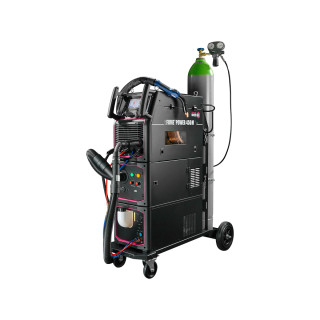
If you need a machine where the mode can be adjusted precisely for different tasks, it is worth paying attention to semi-automatic welding machines. The more precisely inductance in a welding machine can be adjusted, the easier it is to adapt the process to a specific job and achieve the required softness or harshness of the arc.
Inductance is needed to control the rate of current rise at the moment of short circuit. It is this parameter that affects the softness or harshness of the arc, the amount of spatter, metal transfer, and welding stability. If you understand what inductance in a semi-automatic welder is and adjust it together with the other parameters, you can achieve a cleaner weld and a more predictable result.