

-320x320.jpg "MIG/MAG Welding Machines")
-320x320.jpg "TIG AC/DC Welding Machines")




-320x320.jpg "Electrodes for High-Alloy Steel")
-320x320.jpg "Surfacing Electrodes")
-320x320.jpg "Electrodes for Cast Iron")








-320x320.jpg "Welding Masks")




-320x320.jpg "Welding Machine Carts")






How to choose a welding helmet?
Published:
20/07/2026
A welding helmet protects the eyes, face, and skin from ultraviolet light, infrared radiation, sparks, metal spatter, and high temperature. If protection is chosen incorrectly, it becomes harder for the welder to see the weld, the eyes get tired faster, and the risk of injury increases. That is why the question of how to choose a welding helmet correctly is important for both professionals and home users.
The choice of a welding helmet depends on the process, current, working conditions, and frequency of use. For occasional repair, a simple model may be enough, but for regular welding, an auto-darkening helmet with an automatic filter, adjustable shade, reliable sensors, and a comfortable fit is more convenient.
What types of welding helmets are there?
Welding helmets can be classic or automatic. A classic model has fixed dark glass. It is simple, affordable, and does not require power, but before arc ignition the working area is harder to see. The welder has to lift the helmet, position the electrode or torch, and then lower the protection.
An auto-darkening helmet works differently. In its normal state, the light filter remains clear, and after the arc appears, it darkens in a fraction of a second. This is convenient for tack welds, short seams, and welding in an awkward position. The welder sees the part before ignition and controls the start of the weld more easily.
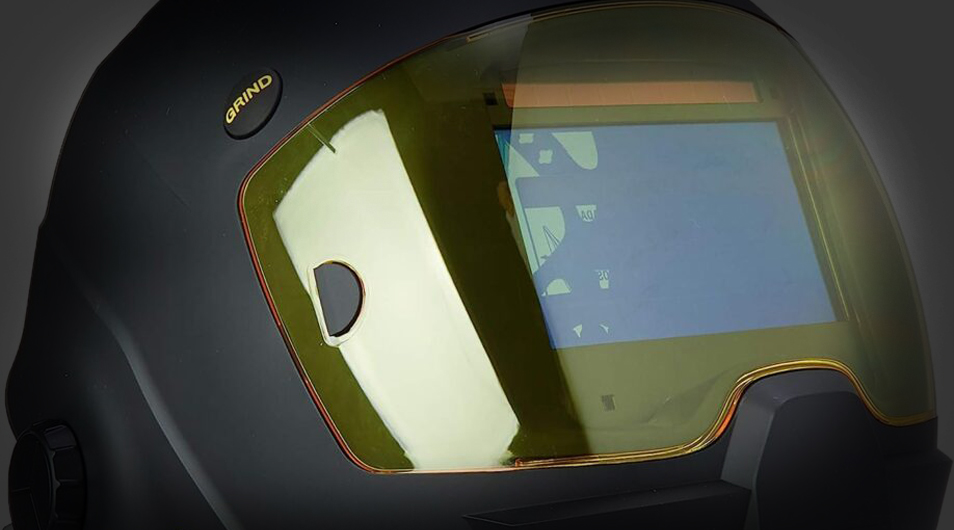
There are also models with grinding mode, an enlarged viewing window, sensitivity adjustment, and delay control. For full protection, it is important to choose not only a helmet, but also other personal protective equipment for specific working conditions.
Which characteristics to consider when choosing
Before buying, do not look only at the appearance. The helmet must suit the welding type, react quickly, provide a good view, and sit comfortably on the head. If the optics are cloudy, the window is small, and the headgear presses, working will be harder even with a good welding machine.
When choosing, it is worth evaluating these parameters:
- type of light filter and its optical class;
- shade range and ease of adjustment;
- reaction speed after the arc appears;
- number of sensors and their position;
- viewing window size and viewing quality;
- power type, battery, and possibility of replacement;
- weight, ergonomics, headgear adjustment, and shell strength.
For occasional household tasks, a simpler model can be chosen. If welding is performed often, it is better not to save on the light filter, sensors, and comfort. These parameters affect safety, work accuracy, and welder fatigue.
Before starting work, it is useful to check the helmet reaction, make sure the protective lens is clean, and adjust the headgear. If the glass is scratched, visibility becomes worse, so the outer lens should be replaced on time. This simple check reduces the risk of mistakes during arc ignition and helps maintain normal visibility during welding.
Optical class of the light filter
The optical class of the light filter shows how clearly the welder sees the working area through the darkened window. The better the optics, the fewer distortions, cloudiness, glare, and uneven shading there are. This is important for TIG welding, thin metal work, and joints where precise weld pool control is required. Good optics reduce eye strain and help guide the electrode or torch more confidently.
Shade level
Shade level is selected according to the welding type and welding current. A weaker arc requires a lower shade, while higher currents require a darker shade. If the filter is too light, the eyes receive extra strain. If it is too dark, the welder sees the pool, edges, and movement direction worse. Auto-darkening helmets are convenient because they have an adjustable shade range for MMA, MIG/MAG, and TIG.
Light filter reaction speed
Reaction speed shows how quickly the light filter darkens after the arc appears. The faster the reaction, the better the eyes are protected at the moment of ignition. If the delay is too long, the welder may feel flashes and discomfort. For regular welding and short tack welds, it is better to choose a helmet with stable reaction.
Number of sensors
A sensor detects the appearance of the arc and sends a signal to the light filter. Simple helmets usually have two sensors, while advanced models may have more. The more sensors there are, the lower the risk that a hand, part, torch, or head position will block one of them. For difficult positions, it is better to choose a helmet with several sensors.
Viewing window size
The window size affects visibility and weld control. A small window makes the helmet lighter and cheaper, but limits visibility. A large window helps see the part, edges, pool, and movement direction better. For short household work, a standard window is usually enough, but for regular welding, an enlarged window is more convenient.
Power type
Auto-darkening helmets can work from a battery, solar cell, or combined power supply. A combined system is convenient: the solar panel supports the light filter during welding, while the battery helps provide stable start-up. Before buying, it is worth checking whether the battery can be replaced and testing the helmet after long storage.
Weight and ergonomics
Even a high-quality helmet will be uncomfortable if it is heavy, sits poorly on the head, or presses on the neck. Weight, balance, headgear adjustment, and shell shape affect fatigue. The shell should be strong and resistant to sparks, spatter, and heat. Polycarbonate or another impact-resistant material is often used.
Which welding helmet is suitable for different welding types
For MMA welding, reliable protection, spatter resistance, and a comfortable fit are important. This process is often accompanied by a bright arc, scale, and metal particles, so the shell should cover the face and neck well. For occasional work, a simple helmet is suitable, but an auto-darkening helmet will be more convenient with frequent ignition.
For MIG/MAG welding, it is better to choose a helmet with adjustable shade and good visibility. When working with a semi-automatic machine, the welder often guides a long weld, so it is important to see the pool, edges, and movement direction. An enlarged window and comfortable headgear will be a big advantage.
For TIG welding, high-quality optics, sensor sensitivity, and correct operation at low currents are especially important. The arc can be less bright, so a weak helmet may sometimes react unstably. For TIG, it is better to choose an auto-darkening helmet with precise sensitivity adjustment.
For grinding, a separate mode is useful, where the light filter does not darken from sparks. This makes it possible not to change the helmet between welding and cleaning. But before welding, it is important not to forget to turn off grinding mode, otherwise the protection may not react in time.
If a universal model is needed for home and workshop use, it is better to choose an auto-darkening helmet with adjustable shade, several sensors, comfortable headgear, and a strong shell. In the welding helmets section, you can choose options for different processes and working conditions.
Summary
How to choose a welding helmet correctly depends on the welding type, light filter quality, shade level, reaction speed, number of sensors, window size, power supply, and ergonomics. For occasional repair, simple protection is suitable, but for regular work it is better to choose an auto-darkening helmet with good optics, a reliable sensor, and a comfortable fit.